
Buy traffic. Or rent IPs.
Residential traffic from providers such as Infatica ↗ and GeoNode ↗.
For ISP / datacenter: leased IPs or subnets, connected to proxy servers.
Proxy platform engineering
We build the software behind proxy services — from routing and traffic accounting to customer accounts, billing, and APIs. Start a new platform or bring us into the part of your existing system that needs work.
01 / How your proxy business works
You source the traffic or IPs, set your prices, and own the customer relationship. We build the platform that turns that supply into a service people can buy and use.
Residential traffic from providers such as Infatica ↗ and GeoNode ↗.
For ISP / datacenter: leased IPs or subnets, connected to proxy servers.
Sell traffic packages or IP plans at your prices, with checkout, a customer dashboard, and an API under your brand.
Ready-made platform or custom developmentHelp customers collect public data, monitor search results, and verify ads across locations.
You manage the offer and customer relationships.
App, script, or data tool
Public pages & APIs
Count bytes in both directions. Update usage and remaining allowances.
Upload + download → billable usageWrite completed request records to the analytics database for customer reports and operational visibility.
Customer credentials identify the account, purchased package, and available allowance.
You control the commercial offer. We connect supply, access, billing, and reporting in one working product.
Build my proxy businessA simplified request lifecycle based on ProxyRequest. Provider names are examples of residential supply. Your providers, infrastructure, and business rules define the final implementation.
02 / Your starting point
The starting point can be a business requirement, an existing backend, or a proxy network that needs a customer-facing product.
Turn your proxy infrastructure into a product customers can buy, configure, and use. Define the access model, packages, account flows, and operator tools together.
Replace a routing component, fix gaps in traffic accounting, or connect disconnected systems. We map the current dependencies before agreeing on the migration.
Bring us a defined problem — a proxy engine, location service, billing integration, customer API, or dashboard. We establish how it fits your existing stack.
03 / Development scope
A working proxy service needs consistent rules across connections, customer access, and usage. We develop these layers together or take responsibility for a defined part.
Connection handling, authentication, pool selection, and routing rules. Our project experience covers TCP and UDP with HTTP, SOCKS5, and SOCKS5 UDP ASSOCIATE.
Residential, ISP, datacenter, and mobile pool models; geographic selection; rotation and sticky sessions. Availability and session behavior follow the capabilities of your network.
Credentials, IP allowlists, traffic allowances, and connection limits connected to the customer’s products and account state.
Usage records linked to customers, credentials, and products. Balance updates, consumption reports, and operational views built around the same accounting model.
Packages, subscriptions, order flows, payments, and invoices. Connect your existing billing system or build the workflows required by your service.
Customer tools for buying access, generating proxies, and checking usage; operator tools for managing accounts, products, and network resources.
04 / Selected project experience
These projects show how routing infrastructure becomes an operational product, with customer access, usage records, and day-to-day management.
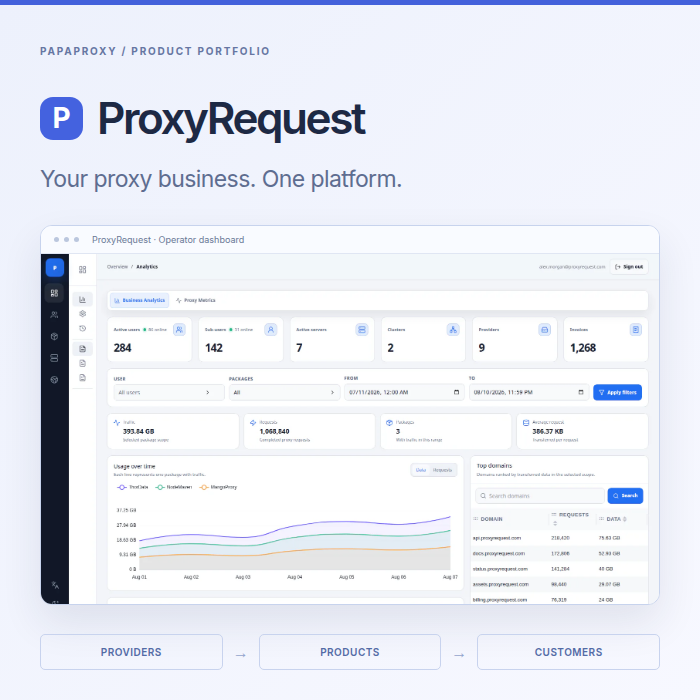
Proxy business platform
Routing, customer access, products, and ordering in one platform. Operator and customer dashboards work alongside an API for integration with an existing business.
View project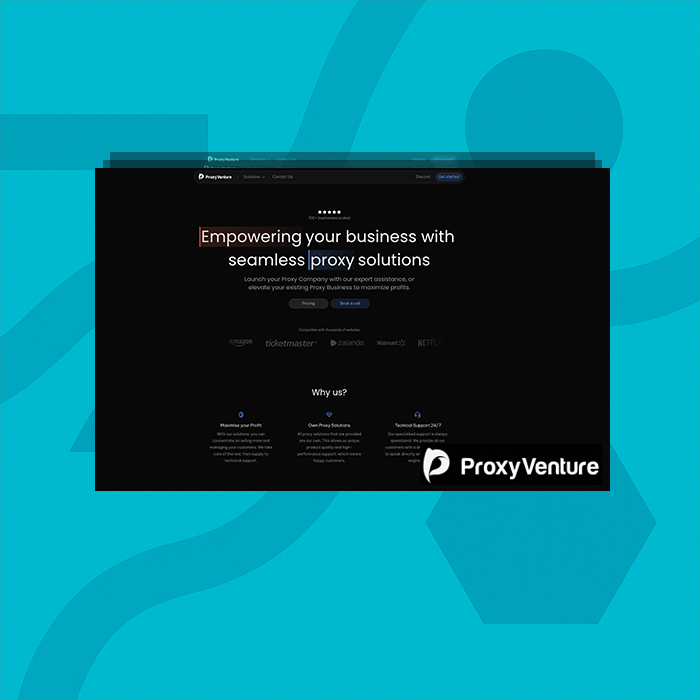
Network operations & accounting
Our proxy platform powers ProxyVenture’s residential pools. Customer allocations guide routing, and usage accounting feeds the service’s dashboard and billing views.
View project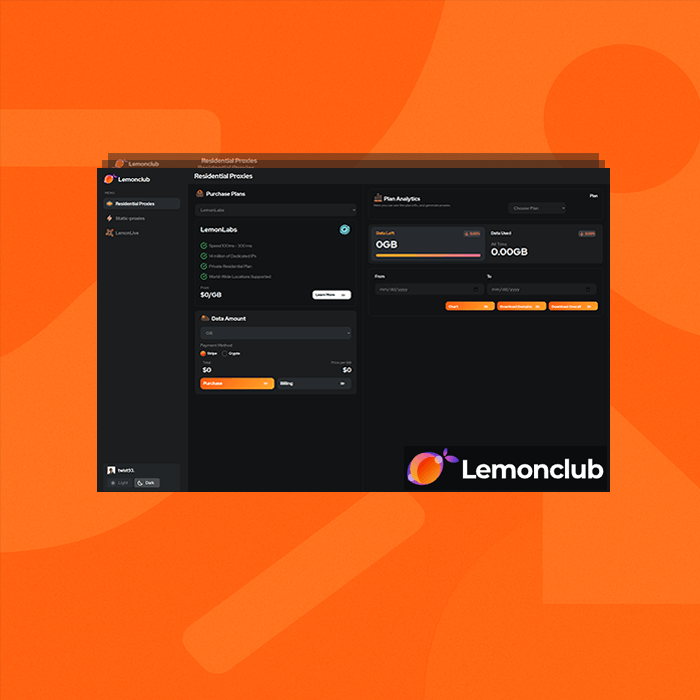
Proxy engine & customer workflows
LemonClub uses our proxy engine for its residential pools. Customers select regions, configure sessions, generate connection lists, and track their remaining traffic in one account.
View projectProxy operations and static pools connected to an existing business backend.
Provider connections, inventory, sales, payments, and customer access in one workspace.
Customer plans connected to traffic allowances, connection limits, and proxy settings.
Residential proxy access with packages, traffic statistics, and billing.
Have a similar system to build or improve?
Tell us about your projectFor a service with its own product rules and architecture. We define the system boundaries, implement the agreed components, and prepare the platform for operation.
For an established business with infrastructure worth keeping. We agree on interfaces, migration steps, and verification before replacing or adding a component.
Where ProxyRequest fits the requirements, we can configure the platform and build the surrounding integrations. We identify the gaps before choosing this route.
05 / Delivery
Review customers, proxy pools, product rules, current systems, and expected traffic.
Requirements & system boundariesMap routing, access rules, data ownership, integrations, and the deployment model.
Architecture & delivery milestonesImplement the agreed scope and check connection behavior, usage records, integrations, and failure paths.
Working components & acceptance checksPrepare deployment, documentation, and operational handover. Agree separately on ongoing maintenance and new features.
Deployment & support responsibilities06 / Questions & answers
Have requirements that don’t fit a standard brief?
Discuss your scopeYes. We can develop the proxy engine, control plane, traffic accounting, APIs, and customer interfaces as a single project. We start by defining what your service sells, how access works, which network resources are available, and who will operate the platform. The implementation scope follows those requirements.
No. We develop custom platforms and individual components as well as implement ProxyRequest. An existing platform can be useful when its product and operational model fits your business. When it does not, we can design a custom system or work within your current architecture.
Yes. We review how your pools expose connections and location information, and how your backend manages accounts, products, and balances. We then agree on interfaces and ownership of each operation. LemonClub and ProxyVenture use our proxy technology to operate their residential pools.
Yes. A project can cover routing, accounting, an API, a dashboard, or a specific integration. We first trace the component’s dependencies and data flows, then define compatibility checks and a migration approach. Any required changes to neighboring services are included in the scope.
We estimate after reviewing the product requirements, existing code and infrastructure, integrations, and acceptance criteria. A new platform and a single component have very different scopes. We break the agreed work into milestones so the deliverables and dependencies are clear before implementation.
We agree on the hosting environment, repository access, documentation, and handover responsibilities before development starts. Source code and licensing terms depend on whether the work is custom development or an existing platform implementation. Ongoing maintenance and support are scoped separately, including the systems covered and the response expectations.
A short description of your service, the type of proxy resources you operate, and the part you want to build or improve is enough to begin. If available, include your current architecture, API documentation, traffic expectations, and any launch or migration constraints.
Tell us about your proxy network, your customers, and the software you already have. We’ll discuss the development scope, integrations, and a practical starting point.
Prefer a direct conversation?
Contact us on Telegram ↗
We’ll reply using the contact you provided to discuss your project and the next steps.