GeoNode
Client engineering / SDK & backend integration

A Rust SDK inside GeoNode’s proxy network.

We developed an SDK that turns participating devices into proxy exit nodes for GeoNode. Our team studied the existing backend, completed the SDK’s integration with the platform, and built the supporting tools for working with it.

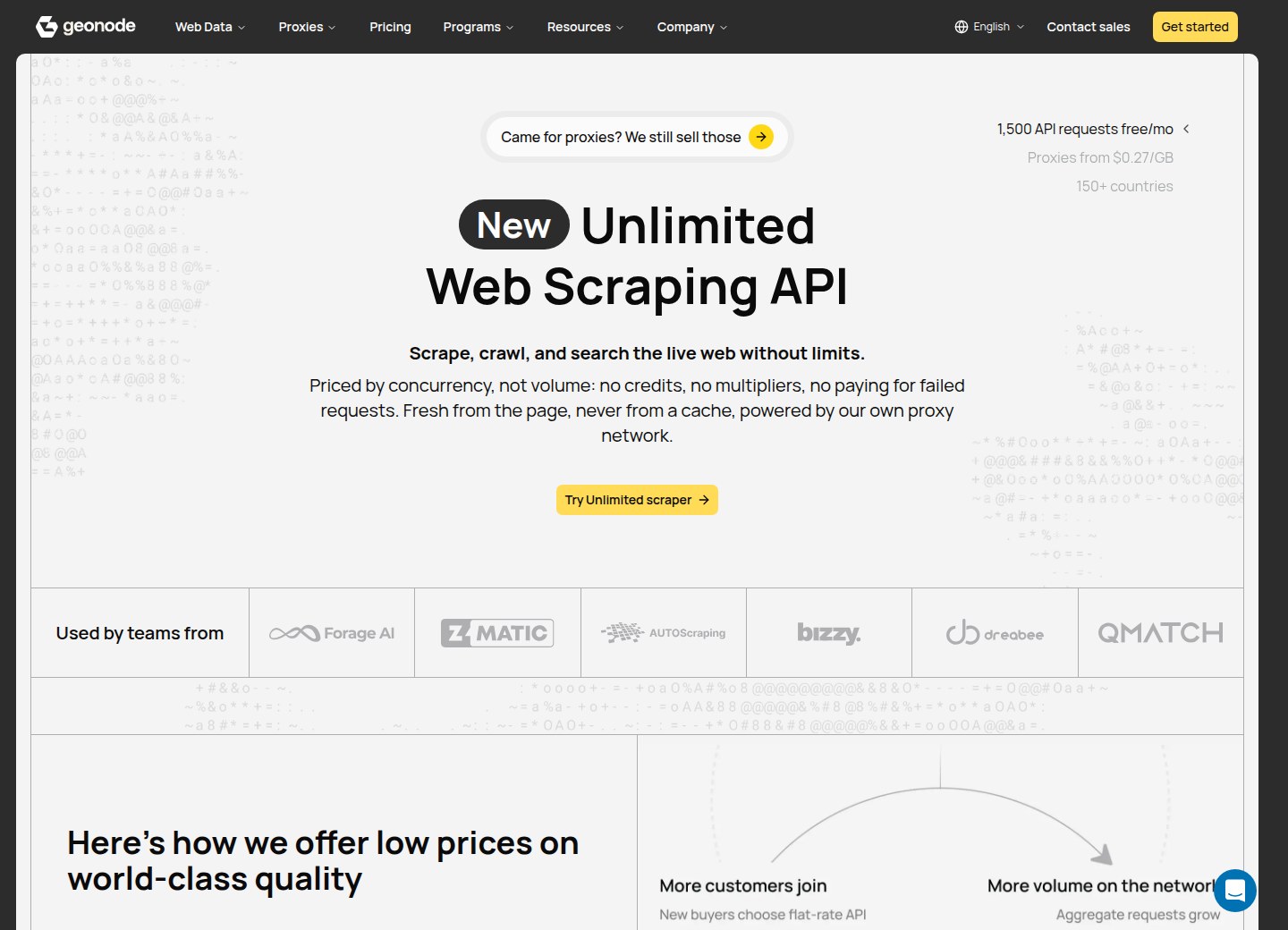
GeoNode’s public website, introducing its Web Scraping API and linking to its proxy services
GeoNode’s public website · September 2026
Our work
Exit-node SDK & platform integration
Implementation
Rust across five operating systems
Network support
SOCKS5 & SOCKS5 UDP ASSOCIATE
01 / The engineering brief

Build the device component around an existing platform.

GeoNode operates proxy infrastructure and web data services. Our work focused on the software running on exit-node devices and its connection to GeoNode’s backend. That required understanding how the existing platform works, then carrying the SDK through the full integration.

Understand the backend

Work through the platform’s existing interfaces.

Our team examined the backend architecture and the way it interacts with device software. This gave us the integration requirements for connecting the Rust SDK to GeoNode’s platform and handling proxy traffic within its network.

Complete the integration

Deliver the SDK and the tools around it.

We implemented the SDK’s integration with GeoNode’s backend and built a supporting toolkit for integrating and working with it inside the platform. The delivered work covers both the device component and the software needed to connect it to the existing service.

02 / SDK in the network

The device is the exit point.

Devices running the SDK connect to GeoNode’s platform. Proxy traffic passes through those devices to its destination, with the SDK handling connections and enforcing safeguards around local and protected resources.

Proxy trafficSOCKS5 · TCP & UDP
  1. Customer side

    Proxy clients

    Requests enter
    GeoNode’s network

  2. Existing infrastructure

    GeoNode platform

    Backend integration
    Connection to SDK nodes

  3. Our Rust implementation

    Exit-node SDK

    WindowsAndroidiOSmacOSLinux
  4. Public internet

    Destinations

    Traffic exits through
    the participating device

SDK ↔ backend

Integration & supporting toolkit

Built around GeoNode’s existing platform and the Rust SDK.

Enforced by the SDK

Device-side safeguards

Block local network scanning and access attempts to protected resources.

Component overview of our integration work. SDK nodes connect to the platform; proxy requests exit through the devices, and responses return through the same path.
03 / Proxy traffic & device protection

Protocol handling with safeguards at the exit node.

The SDK implements SOCKS5 proxy traffic handling, including SOCKS5 UDP ASSOCIATE for UDP communication. Connection processing and device-side protection are part of the SDK itself.

Because requests leave through a participating device, the implementation also needs to control what those requests can reach. The SDK includes protection against local network scanning and attempts to access protected resources.

SOCKS5
Proxy connection handling for TCP traffic, integrated with GeoNode’s network.
SOCKS5 UDP ASSOCIATE
UDP proxy support within the SDK, alongside the TCP connection path.
Local network protection
Built-in safeguards against using the exit-node connection to scan the device’s local network.
Protected resources
Restrictions on proxy requests attempting to reach resources that should remain inaccessible through the SDK.
04 / Resource-conscious implementation

Proxy performance within a device’s resource budget.

We developed the SDK in Rust with particular attention to allocation behavior and device resource use. The optimization work supports fast proxy traffic handling while keeping the SDK’s operating overhead low on mobile and desktop devices.

Memory

Allocation efficiency

We optimized memory allocations in the SDK’s traffic-handling code to reduce the work performed while processing proxy connections.

Device resources

Low operating overhead

The implementation is tuned for efficient use of device resources while the SDK operates as a proxy exit node.

Networking

Fast proxy handling

The Rust implementation brings connection processing and TCP and UDP traffic handling into the same optimized SDK.

05 / Platform delivery

One Rust SDK. Five target platforms.

The SDK builds for Windows, Android, iOS, macOS, and Linux. The shared Rust implementation carries the proxy functionality and backend integration across the supported mobile and desktop environments.

Delivered engineering scope

  • Rust SDK for participating proxy exit-node devices.
  • Complete integration with GeoNode’s existing backend.
  • Supporting tools for integration and working with the SDK.
  • SOCKS5, SOCKS5 UDP ASSOCIATE, and device-side safeguards.
  • Builds for all five supported operating systems.
Engineering stack

Technology behind the platform.

The SDK is written in Rust and integrated with GeoNode’s existing backend. The implementation brings proxy traffic handling, local resource protection, and device resource management into the same SDK.

Rust

  • Cross-platform SDK for proxy exit nodes.
  • SOCKS5 and SOCKS5 UDP ASSOCIATE traffic handling.
  • Local network safeguards and resource-efficient device operation.

SDK platform support

Full SDK support for the following operating systems.

  • Windows
  • Android
  • iOS
  • macOS
  • Linux

Network support

Full support for TCP and UDP traffic.

Transport
TCP · UDP
Proxy protocols
SOCKS5 · SOCKS5 UDP ASSOCIATE

The SDK runs on exit-node devices and includes safeguards against local network scanning and access to protected resources.

Ready to Transform Your Business Performance?

Schedule a consultation with our proxy infrastructure experts and discover how enterprise-grade solutions can accelerate your growth.