Manage the full package lifecycle
Package configuration, customer access, allowances, and limits stay connected. The platform tracks consumption and remaining traffic as customers use their proxy access.
We developed ClaroEdge’s proxy platform and API, connecting package management and traffic accounting to a Go proxy engine. Protocol conversion, quality selection, and domain-based SmartRouting give the service more control over how each request reaches its destination.
ClaroEdge’s platform brings the standard operations of a proxy service into one backend: customer access, packages, provider configuration, connection handling, and usage records. Its API connects these operations to the product’s customer-facing workflows.
Package configuration, customer access, allowances, and limits stay connected. The platform tracks consumption and remaining traffic as customers use their proxy access.
Seven different upstream providers are supported out of the box. The platform brings their connections into the same package, access, and routing workflows.
Go handles traffic metering and usage accounting alongside the proxy engine. The backend and API make consumption and available traffic accessible to the service interface.
A provider may offer the right proxy resources without supporting the protocol a customer’s tool expects. ClaroEdge’s Go engine bridges that gap by converting between HTTP and SOCKS connections in both directions.
The customer-facing connection and the upstream connection can use different protocols. This makes a provider usable even when it lacks the protocol required on the client side.
We developed custom proxy quality scoring support for ClaroEdge. Customers can request a quality level through username parameters, using the same proxy connection workflow as their other settings.
quality-mediumquality-highA page can need a residential IP for its main requests while serving most of its bytes from a CDN. Sending every image, font, and other heavy asset through the residential route consumes traffic that could be served through a cheaper connection.
SmartRouting lets the service define a list of destination domains that use preconfigured static proxies. Main requests continue through residential providers, while selected CDN domains use lower-cost ISP traffic, reducing residential bandwidth consumption.

Our work covers the proxy platform and API: package operations, upstream integration, connection handling, routing, and accounting. ClaroEdge’s product interface presents these capabilities through account, ordering, network statistics, and proxy generation screens.
Connect the customer’s account to its package, allowance, and access settings.
Use the generator to choose protocol, session settings, and the format of the connection list.
Show remaining traffic and network usage, with request and domain views for understanding activity.
ClaroEdge’s website and customer interface show the product around the platform: network consumption, connection settings, and traffic ordering.
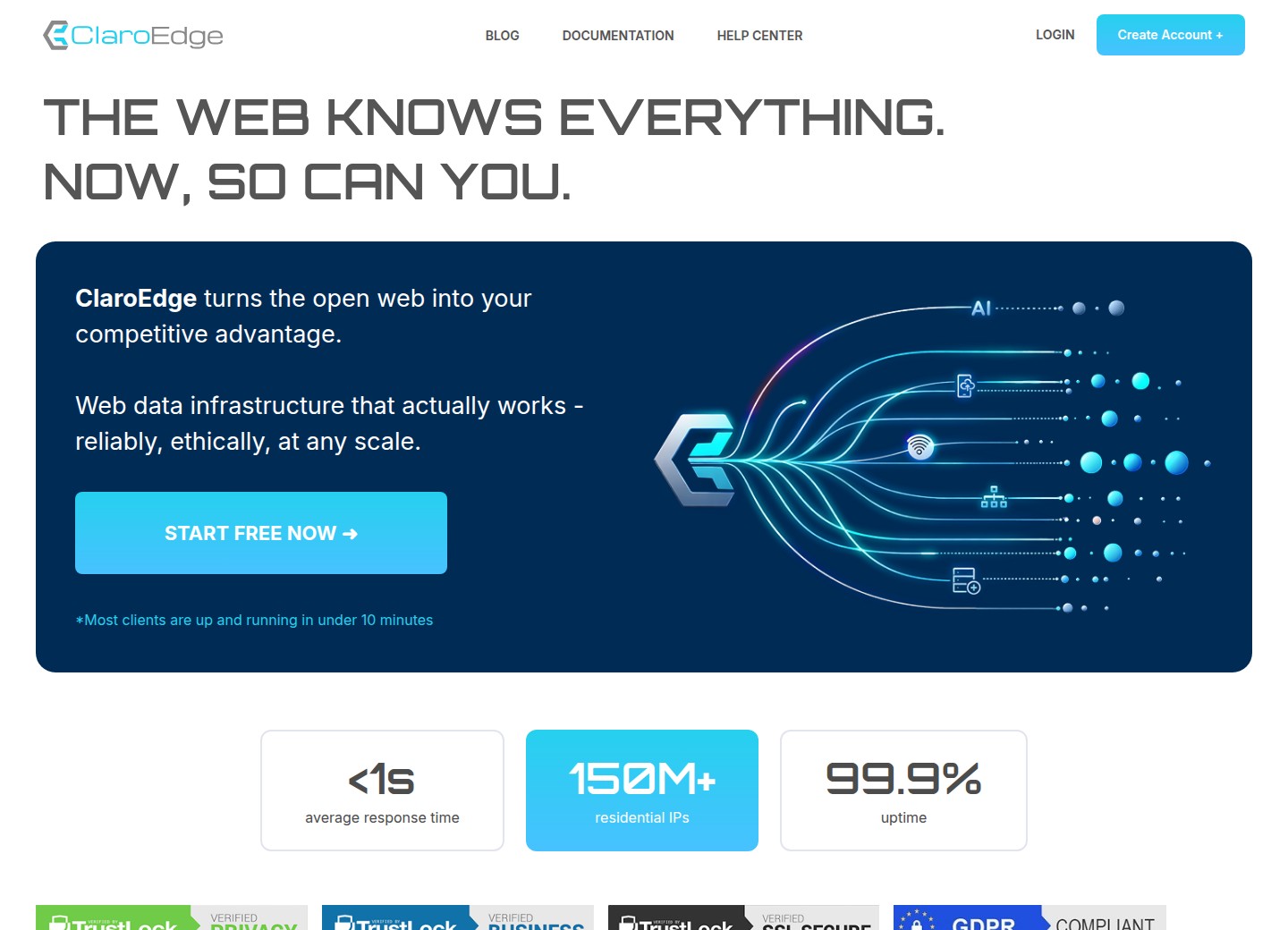
01 / Product website. ClaroEdge’s introduction to its web data infrastructure.
Open full-size image ↗Go powers ClaroEdge’s proxy engine, protocol conversion, routing, and traffic accounting. The Python/Django control plane connects packages, customer access, and provider configuration through the API. PostgreSQL stores operational data, ClickHouse supports analytics, Redis provides caching, and NATS carries messages between components.
Schedule a consultation with our proxy infrastructure experts and discover how enterprise-grade solutions can accelerate your growth.